Hymnal, apartheid, and a soldering iron (email from Amy)
I tried to write earlier, but the phones were out in Anker. They were out for nearly two weeks. They go out pretty often. Sometimes I hate elephants.
Overnight guests
I got some groceries on Thursday, so I have lots of food now (I actually found sour cream not Omaere (sour milk with porridge) which will make the chilli I made taste better.) Then I came back and had my first overnight guests since I came to Anker. It was a VSO volunteer who I met over July 4th and a couple of members of the Opuwo youth group. They were here for one day working with the Anker youth group. They were planning on spending the night in tents in Mr. Geiseb's yard, but it is really really cold here at night (it's often only a few degrees above freezing.) Anyway, I was really glad to have them. I so rarely get to host people and it was nice to talk to another volunteer.
Trading Computer lessons for Chickens
This week I've been helping two of the teachers with computers that they got (this brings it to four working computers including mine in Anker.) They're doing some sort of computer class and the computers are part of that. I have now become the 24-7 tech wizard and since the problems are mostly easy things (installing drivers, registering Windows, etc.) I get to feel like I'm a genius without having to work too hard. I told Mr. Narebeb that I would give him computer lessons if he gives me chicken lessons (I really want to try to start raising a few egg laying chickens.)
Grants for new windows
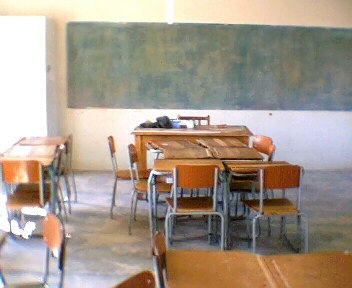
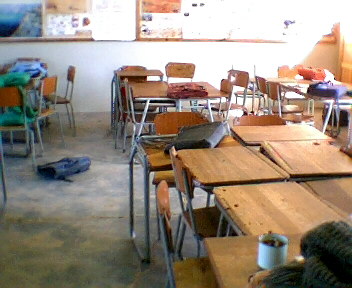
I have been working on the grants that I've been writing. The computer grant is basically done. We just had to wait for the phones to come back on to get some quotations faxed to us (we're going to try to get 4 refurbished workstations and a refurbished server.) It's through a refurbished computer center and it's really not very expensive at all. I think the computers must be donated and they're mainly just trying to recoup the labour expenses. Also, this Wednesday I spent most of the school day touring the hostel and making notes on the damage (after my classes of course. I only have 4 classes on Wednesday, all at the beginning of school, so I have decided that on Wednesdays I will close the library and only work on grants.) Apparently about 1/3 of the windows panes in the hostel are broken or missing (which is lower than I thought. It looks like at least half are broken or missing.) In the school about 10% are broken or missing. I have been writing a grant for the windows and I'm really hoping that we can get the money for 507 window panes, some latches, and one window frame. I had some really great news this week. I had assumed that we would need some sort of builder to come in and do the work, but they told me that all you need is the window pane and putty and the teachers, school board members, and learners will do the work themselves. That would have been good news in and of itself, but also apparently the window panes cost N$12-15 each and the putty costs N$20 and covers 9 windows. That means the total project will cost under US$2,000 which is significantly less than I expected (I was guessing at least US$5,000.) My next task is to find some place that takes construction and rennovation grants from African
schools.
More grants
I also need to find some places to send the computer grant to and I suppose I should start looking for funding for the library furnishings grant I wrote (although it's sort of a secondary priority to the other two grants and it will be a lot easier to fund because I think we can paint AIDs ribbons on the shelves or something and get money from PEPFAR (there is a load of money out there if you can connect your project to HIV/Aids. I would love to get the windows funded by PEPFAR, but I can't figure out how to connect windows with AIDs except maybe to claim that the hostels care for a large number of AIDs orphans which, although true, is difficult to prove.) I like working on grants. It makes me feel a sense of accomplishment (which is much rarer in the classroom.) and I feel like it's something I can fix. It will be a long uphill battle for these windows--- I think that in the end grants are held together by a lot of hope and by people holding on with both hands and refusing to let go--- but at the end of it I truly believe that it will be successful. Not just that, I actually know what success looks like in that project--if there are windows it was a success, if there aren't then it wasn't.
Parent's day
Things aren't that easy in the classroom. We had a parent's day a few weeks ago and the mother of one child who is in my grade 6 class came. This kid has a lot of trouble with reading comprehension and with following directions. Anyway, his mom signed the register, taking a good five minutes and a lot of concentration to barely manage to shakily print her surname. It's the way things work in the homeland--apartheid's fingerprints. I guess I see it as pretty impressive that a kid whose parents can't read or write and have always been underpaid farm hands for white farmers can actually read and write with some understanding, not just in English, but in KhoeKhoe too. Anyway, grants are a nice break from those complications--an easier world where goals, even if they seem unscalable, are at least clear and measurable, with a predictable path to follow. Teaching English has not been that experience for me.
Hymnal
Church on Sunday was good. The women I was sitting next to kept tryingto hunt down a hymnal for me to sing from, taking one away from some ofthe church elders at the front at one point. They are always really happy when I sing in the church. Then, after church, when we all shake hands and there are announcements outside the church, they asked me my birthday and then they spoke very fast in KhoeKhoe. I definitely heard my name. I think, with my limited understanding of KhoeKhoe, that they are planning to take up a collection to buy a hymnal for me for my birthday. Sometimes I am really overwhelmed by generosity.
Namibian people groups
Last Monday I had my seventh graders give "My Favourite Things" speeches. Unfortunately I also had to warn them that it is NOT OK to write ethnic slurs against other tribes in their exercise books (one sixth grader wrote about how the Owambos steal cars, another seventh grader said something in his speech about the San (who used to be called Bushmen) and there seemed to be just general talk about the China(Chinese people) in Namibia.) It's really a little odd because the Damara are pretty low on the pecking order themselves (at least the way I see it. These are all my personal observations, not some sort of authoritative view of racial politics in Namibia. They don't represent the Peace Corps, American government, or really anybody's thought but my own.) They are black, unlike the whites, coloured people (here in Namibia and in South Africa that term refers to people of mixed ancestry, usually white and Nama. In America most coloured people would be considered white.), and the Namas, which, in this society still reeling from the scars of apartheid, means less economic power. They don't vote SWAPO (a political party—the South-West African People's Organisation, it's somewhat communistic, but Namibia is a democracy, they are just sympathetic to communism since communist countries, unlike the US, helped them win their freedom), unlike most of the Owambos, Caprivians, and the Cavongans. Most Damaras generally vote DTA, and in Namibia SWAPO is the only political party that has really any real power (it holds all but two or three seats in Parliament and the president, Hifikepunye Pohamba is SWAPO, as is Sam Nujoma (a controversial revolutionary hero—think George Washington, except with a lot more animosity aimed at him.)) The Hereros, who also have both of those strikes against them, are, I don't know how to explain it, prouder maybe. They tend to be suspicious of outsiders and they seem to have a strong pride in their own culture. I think it comes from a cultural identity that was scarred by the Herero massacre in the 1800s (a genocide when they were literally hunted down like animals and poisoned by people who they thought were helping them.)
Apartheid
Anyway, I wish there were less complicated racial and tribal politics. I wish my kids could see that fighting for a spot a little bit higher than the next tribe is what helped keep apartheid in place. I wish they could see that it splits them up from people who should be their natural allies (especially the San and Namas, KhoeKhoe and KhoeSan are languages that are very similar and the cultures have other similarities.) I also wish they would have more pride in their own identity. I hate that they straighten their hair and rub baby powder on their faces to look more "white." I hate it when they call each other "San" or "China" to make fun of each other. I wish they would know that their hair and their skin is beautiful just the way it is. I wish they would fight the true injustices instead of fighting each other. I don't know. I was talking to a friend who lives up in Opuwo and we were talking about how apartheid isn't really gone. So many people still have apartheid burned onto their soul. I think the worst part is that I know it will take many decades to heal. I mean, look at America. We're had 40 years since the end of injustice that was far less invasive than apartheid and we still haven't overcome many of the problems that it caused.
A soldering iron
OK, enough political talk. I got a package recently that had a soldering iron in it. I am pretty excited to try to use it to make a cell phone antenna (once I find where I put the plans) but I've already used it. I got sick of spending half of my classes playing Solomon and deciding between disputes over who owned a pen. So I told all of the 7^th graders to bring their pens to class and I used the iron to burn their names into the plastic. Hopefully it works because if I hear, "Miss, he is stealing my pen," one more time I think I might have to hurt someone.
End of the term tiredness
I was really really tired last week. I was longing for the weekend by Tuesday. I don't know what it was. I'm hoping I'll be better next week because we still have a good month left of the term (although really, it's only about 2 weeks of teaching and 2 weeks of exams.) So far it has been pretty good. I wrote my tests this week. I am worried that they are too hard and I am worried that they are too easy. I get all panicky about exams, even though the kids always do badly on them, regardless of whether I'm worried that they're too easy or too hard, so I suppose I
should just take a chill pill.
School politics
The inspector decided not to show up at our school for the school board elections due to "unavoidable circumstances." I think he just didn't want to come out into the middle of nowhere—my school, a nearby country school in Erwee and another school are pretty rural. He'd have to stay in Kamanjab and drive an hour\ or so in the mornings. Anyway, no one knows when we'll get the elections, but there is some tension in the village over the nominees because someone leaked info that one of them is going to get a job at the hostel. Any work (besides subsistence farming) is kind of fought over here. I don't know what's going on, but some people seem pretty angry.
Trading movies for maple syrup
In the package I also got a bunch of episodes of Mystery Science Theatre 3000 which I have been watching too quickly. In August I have to go to Windhoek for medical stuff (my mid-service physical and dental exam) and I'm going to bring them and some maple syrup (You can't get maple syrup here. My parents sent something called "Mapelene" that you boil with sugar and water to make syrup that tastes wonderfully like American fake maple syrup and apparently the little vial they sent makes 3 gallons of syrup, so I have enough.) because Jason, the volunteer in Windhoek has an enormous collection of movies and I'm hoping I can trade for some.
Polio lessons
In health news, my village got a new health worker this week. She showed up with loads and loads of posters and stuff about polio. So, with all of the info and everything, I decided that my 7th grade science class should take a break from alcohol abuse and talk about polio and how not to get it. We talked about washing your hands (a pretty foreign concept here-- plus one that's difficult to practice since water is hard to obtain if you don't live in government housing. Don't tell my principal, since we're not technically supposed to do this, but occationally kids come to my house with empty paint cans (yes, they carry water in empty paint cans) or 20 litre buckets and I let them fill them from my faucet.) We also talked about using a toilet or outhouse and not using a bush, since waste can seep into the groundwater (this is also a pretty foreign concept and, having been inside the school and hostel toilets, I understand why a kid would choose to go to the river instead.) Then we talked a bit about vaccines and how they work. They wanted to know why you can't take more than two drops of the polio vaccine and be REALLY protected and so we talked about germs and how vaccines are made from dead viruses and a little bit about anti-bodies (I said that the body makes the right type of weapon against each germ and if they have the right weapon already made they can fight off the disease quickly if they ever get it.) Anyway, it was pretty good, although one suggestion for what to do if you get sick with polio was to go to the witch doctor, so there is that. Still, they asked some very good questions and a few of them have even been washing their hands more (if they want to wash them after tea time, at the beginning of science class, I let them.) Oh, I also found an article in a Smithsonian magazine that the library had about the history of polio in America. It said that polio was supposed to be eradicated in 2005. Apparently not.
AIDs effects in my town
I know I don't always talk about the way that Aids affects my community, but that's partially because the stigma keeps a lot of people silent about their status. I have suspicions about people, and I know I teach a lot of orphans, but I have trouble judging the extent of it all. To give you an idea of what the pandemic is doing, this weekend my headmaster is gone planning the funeral of his brother, and two teachers are at funerals for members of their family, and this is an average weekend. Next weekend there will be another 2-4 funerals, and the weekend after
that the same.
OK, this was a really random email with lots of serious stuff. Sorry about that. Next time I promise I'll only write about funny teaching stories and cultural misunderstandings or something. Well, maybe not, but I'll be lighter next week at least. Take care of yourselves
PO Box 90
Kamanjab, Namibia
AFRICA
Labels:
Emails from Amy
0
comments